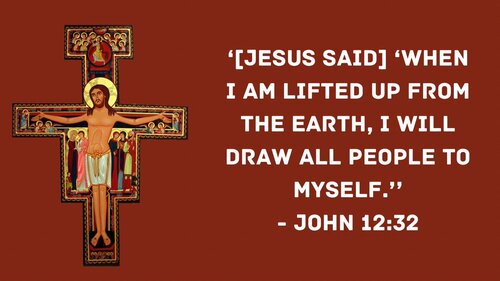
"Now is the time for judgment on this world; now the prince of this world will be driven out. And when I am lifted up from the earth, I will draw all people to myself.” He said this to show the kind of death he was going to die.
~John 12:31-33
__________________________________________
Each year we go through Holy Week and the Paschal Triduum (Friday, Saturday, Sunday) of Jesus’ story. The Paschal Triduum is the phrase to refer to the climax of Jesus' story. Throughout Christian history, it has always been these three together. You can't have any of these on their own. They lose context and meaning. Friday on its own is a tragic death. Saturday makes no sense without Friday. Easter is fun, but has no meaning apart from Friday and Saturday. Easter looks back on Friday and Saturday as vindication. It does not overcome Jesus' death on the cross; it confirms Jesus' death on the cross as the way, the truth, and the life, the true revealing of the Father (John 14:6).
We are used to looking at Good Friday through the lens of Easter. We know how it will end. Unfortunately, this can steal the power of Good Friday. It's a totally different experience to put ourselves in the shoes of Jesus' disciples, of the women who followed, of the Roman soldiers and others.
Can you imagine being there as the day goes on and things continue to unravel? First, Jesus stands before the religious authorities. Then, he goes to the political rulers. Then, he's handed over to be flogged.
At this point, Jesus' followers understand clearly this is not going to end well. The religious authorities and Roman powers are just having their way. They are steamrolling over Jesus, just like they have done to all non-citizens and slaves who don't accommodate to Rome's ways. Jesus was bringing something new and good to the world, yet it upset the status quo, so they conspired to get rid of him because it was in their power to do so.
But how could it go so badly? Isn't this Jesus, the Son of God? If the Lord is with him, how can things go like this? Isn't he more powerful than Rome? It should be Jesus who is steamrolling over the corrupt religious and political powers!
This is what Jesus' followers wanted. They wanted to see Jesus win. They wanted a Jesus who would overcome. Fix the problem. But they could only understand this through the grid of human thinking. That's why Peter objected so strongly when Jesus said he was going to suffer and die (Matthew 16:21-22). That is why Jesus responded so strongly to Peter's objection when he said, "Get behind me, Satan!" (Matthew 16:23). When we try to fit God into our box of glory and triumph, we lose Jesus.
I wonder how often we confuse God's activity with things going well from our human perception and expectations. Or we think that things going well are "proof" that God is active and working. And I wonder how often we miss the profound ways God might be more present and active in circumstances or experiences that seem like things are going "badly," or look unimpressive, or even like losing to the powers, systems, or circumstances of our broken world.
_________________________________
The dismay and disillusionment must have been heavy. The failure to understand must have made things so distressing. Any hope that God would make things right is spiraling down the drain. It doesn't seem like there's any way to stop this. The women begin to weep. A deep, aching emptiness begins to rise up. No one knows whether to run home or stay and see what happens.
And then Peter, likely not alone, begins to distance himself from Jesus. Both Matthew and Luke say that Peter followed Jesus "at a distance" (Matthew 26:58; Luke 22:54). Things are going so sideways. And if you know how Rome works, you don't want to be even close to guilty by association. If they're running Jesus through the gauntlet of a political troublemaker, someone who claimed "kingship," you'd best distance yourself if you want to get out alive.
The fear in Peter's heart must have been profound. At the same time, the pain in his heart over Jesus and realizing what he'd done in denying friendship with Jesus must have been overwhelming.
I wonder how often we do that -- distance ourselves or deny Jesus. Just in normal life, when there's not even a real threat that we'll be handcuffed and beaten like Jesus. We have no idea the serious fear Peter was experiencing. And yet we deny Jesus so easily in our lives: when we prefer some temporary cultural ideologies rather than serve the "least of these" we deny Jesus (Matthew 25:31-46); when we fail to love our brother or sister as Christ loved us, we deny Jesus (1 John 4:16-21); when we forget the great forgiveness of the Lord for us and withhold forgiveness for our enemy (Matthew 18:21-35).
___________________________________
On Good Friday, Jesus experienced shame, mocking, violence, hate, suffering -- not at the hands of purely evil people. He experienced it at the hands of what was at the time pretty "normal" things by "normal" people doing what they felt was "right" according to good Roman and Jewish ways of thinking and living. That's the scary part. It wasn't some extreme level of human sin that put Jesus to death. It was normal human yuck: pride, national arrogance, bitterness, evaluating others based on status, class, or ideology, superiority, judgmentalism, self-preservation.
Yet, how could this happen? Jesus, "God with us," is being pushed around and overcome by this human ugliness. He becomes among those we dismiss, ignore, deny, mock, shove to the curb, laugh at, ridicule, and belittle. He becomes the one that humans in their arrogance consider expendable. Just so we can keep our ways as they are. Just so we can hold on to our status and false-made selves. Everyone has turned on Jesus by the end of this night. NO ONE is exempt. Because it is our basic fallen humanity and the systems we create to protect it that is the problem. When we share in these tragic human ways, we continue to push God to the margins. No impressive church ministries or visions statements will fix this.
Jesus, as God with us, does not come in to reinforce our broken ways but make them "better" by putting Jesus' name on it. He fully dies to it all. God refuses to share in it. This is the sort of human behavior that has to go away. And so Jesus silently lets it kill him. Not because Jesus knows he'll rise again, so it won't really be that bad. As Paul says, Jesus dies to it in order to put it to death (Romans 8:3). It's God's stamp of disapproval.
But it is also God's act of love. God does not come down to crush us, but to absorb our ungodliness and transform it into hope. And this is why it is "Good Friday." Because on this day, Jesus' act of evil-absorbing love created an escape hatch to take us all out of our captivity to "normal" human disfunction. The resurrection confirms this is the way out and into the new creation God intends for the world.
But, as Jesus says, we must die to it all with him.
God of love, open our eyes to the ways we give in to the shallow ways of humanity. By your love, call us to go with you to death, so that we might live. Amen.
Songs for today:
"The Silence of God"
"Beautiful Scandalous Night"
"How Deep the Father's Love"
Each year we go through Holy Week and the Paschal Triduum (Friday, Saturday, Sunday) of Jesus’ story. The Paschal Triduum is the phrase to refer to the climax of Jesus' story. Throughout Christian history, it has always been these three together. You can't have any of these on their own. They lose context and meaning. Friday on its own is a tragic death. Saturday makes no sense without Friday. Easter is fun, but has no meaning apart from Friday and Saturday. Easter looks back on Friday and Saturday as vindication. It does not overcome Jesus' death on the cross; it confirms Jesus' death on the cross as the way, the truth, and the life, the true revealing of the Father (John 14:6).
We are used to looking at Good Friday through the lens of Easter. We know how it will end. Unfortunately, this can steal the power of Good Friday. It's a totally different experience to put ourselves in the shoes of Jesus' disciples, of the women who followed, of the Roman soldiers and others.
Can you imagine being there as the day goes on and things continue to unravel? First, Jesus stands before the religious authorities. Then, he goes to the political rulers. Then, he's handed over to be flogged.
At this point, Jesus' followers understand clearly this is not going to end well. The religious authorities and Roman powers are just having their way. They are steamrolling over Jesus, just like they have done to all non-citizens and slaves who don't accommodate to Rome's ways. Jesus was bringing something new and good to the world, yet it upset the status quo, so they conspired to get rid of him because it was in their power to do so.
But how could it go so badly? Isn't this Jesus, the Son of God? If the Lord is with him, how can things go like this? Isn't he more powerful than Rome? It should be Jesus who is steamrolling over the corrupt religious and political powers!
This is what Jesus' followers wanted. They wanted to see Jesus win. They wanted a Jesus who would overcome. Fix the problem. But they could only understand this through the grid of human thinking. That's why Peter objected so strongly when Jesus said he was going to suffer and die (Matthew 16:21-22). That is why Jesus responded so strongly to Peter's objection when he said, "Get behind me, Satan!" (Matthew 16:23). When we try to fit God into our box of glory and triumph, we lose Jesus.
I wonder how often we confuse God's activity with things going well from our human perception and expectations. Or we think that things going well are "proof" that God is active and working. And I wonder how often we miss the profound ways God might be more present and active in circumstances or experiences that seem like things are going "badly," or look unimpressive, or even like losing to the powers, systems, or circumstances of our broken world.
_________________________________
The dismay and disillusionment must have been heavy. The failure to understand must have made things so distressing. Any hope that God would make things right is spiraling down the drain. It doesn't seem like there's any way to stop this. The women begin to weep. A deep, aching emptiness begins to rise up. No one knows whether to run home or stay and see what happens.
And then Peter, likely not alone, begins to distance himself from Jesus. Both Matthew and Luke say that Peter followed Jesus "at a distance" (Matthew 26:58; Luke 22:54). Things are going so sideways. And if you know how Rome works, you don't want to be even close to guilty by association. If they're running Jesus through the gauntlet of a political troublemaker, someone who claimed "kingship," you'd best distance yourself if you want to get out alive.
The fear in Peter's heart must have been profound. At the same time, the pain in his heart over Jesus and realizing what he'd done in denying friendship with Jesus must have been overwhelming.
I wonder how often we do that -- distance ourselves or deny Jesus. Just in normal life, when there's not even a real threat that we'll be handcuffed and beaten like Jesus. We have no idea the serious fear Peter was experiencing. And yet we deny Jesus so easily in our lives: when we prefer some temporary cultural ideologies rather than serve the "least of these" we deny Jesus (Matthew 25:31-46); when we fail to love our brother or sister as Christ loved us, we deny Jesus (1 John 4:16-21); when we forget the great forgiveness of the Lord for us and withhold forgiveness for our enemy (Matthew 18:21-35).
___________________________________
On Good Friday, Jesus experienced shame, mocking, violence, hate, suffering -- not at the hands of purely evil people. He experienced it at the hands of what was at the time pretty "normal" things by "normal" people doing what they felt was "right" according to good Roman and Jewish ways of thinking and living. That's the scary part. It wasn't some extreme level of human sin that put Jesus to death. It was normal human yuck: pride, national arrogance, bitterness, evaluating others based on status, class, or ideology, superiority, judgmentalism, self-preservation.
Yet, how could this happen? Jesus, "God with us," is being pushed around and overcome by this human ugliness. He becomes among those we dismiss, ignore, deny, mock, shove to the curb, laugh at, ridicule, and belittle. He becomes the one that humans in their arrogance consider expendable. Just so we can keep our ways as they are. Just so we can hold on to our status and false-made selves. Everyone has turned on Jesus by the end of this night. NO ONE is exempt. Because it is our basic fallen humanity and the systems we create to protect it that is the problem. When we share in these tragic human ways, we continue to push God to the margins. No impressive church ministries or visions statements will fix this.
Jesus, as God with us, does not come in to reinforce our broken ways but make them "better" by putting Jesus' name on it. He fully dies to it all. God refuses to share in it. This is the sort of human behavior that has to go away. And so Jesus silently lets it kill him. Not because Jesus knows he'll rise again, so it won't really be that bad. As Paul says, Jesus dies to it in order to put it to death (Romans 8:3). It's God's stamp of disapproval.
But it is also God's act of love. God does not come down to crush us, but to absorb our ungodliness and transform it into hope. And this is why it is "Good Friday." Because on this day, Jesus' act of evil-absorbing love created an escape hatch to take us all out of our captivity to "normal" human disfunction. The resurrection confirms this is the way out and into the new creation God intends for the world.
But, as Jesus says, we must die to it all with him.
God of love, open our eyes to the ways we give in to the shallow ways of humanity. By your love, call us to go with you to death, so that we might live. Amen.
Songs for today:
"The Silence of God"
"Beautiful Scandalous Night"
"How Deep the Father's Love"
No Comments